The Metropolitan Museum of Art
January 30–May13, 2018
The National Gallery. London
11 June – 7 October 2018
  (details), Thomas Cole, View from Mount Holyoke, Northampton, Massachusetts, after a Thunderstorm—The Oxbow, 1836, oil on canvas,  With Cole's masterwork The Oxbow (1836) as its centerpiece, the exhibition will feature more than three dozen examples of his large-scale landscape paintings, oil studies, and works on paper. Consummate paintings by Cole will be juxtaposed with works by European masters including J. M. W. Turner and John Constable, among others, highlighting the dialogue between American and European artists and establishing Cole as a major figure in 19th-century landscape art within a global context. The exhibition marks the 200th anniversary of Cole's arrival in America. The exhibition is organized by The Metropolitan Museum of Art, New York, and The National Gallery, London. |
| The exhibition follows the chronology of Cole's life, beginning with his origins in recently industrialized northern England, his arrival in the United States in 1818, and his embrace of the American wilderness as a novel subject for landscape art of the New World. Early works by Cole will reveal his prodigious talent. After establishing himself as the premier landscape painter of the young United States, he traveled back to Europe. The next section will explore in depth Cole's return to England in 1829–31 and his travels in Italy in 1831–32, revealing the development of his artistic processes. He embraced the on-site landscape oil study and adopted elements of the European landscape tradition reaching back to Claude Lorrain. He learned from contemporary painters in England, including Turner, Constable, and John Martin, and furthered his studies in landscape and figure painting in Italy. By exploring this formative period in Cole's life, the exhibition will offer a significant revision of existing accounts of his work, which have, until now, emphasized the American aspects of his formation and identity. The exhibition will also provide new interpretations of Cole's work within the expanded contexts of the history of the British Empire, the rise of the United States, the Industrial Revolution and the American wilderness, and Romantic theories of history. |
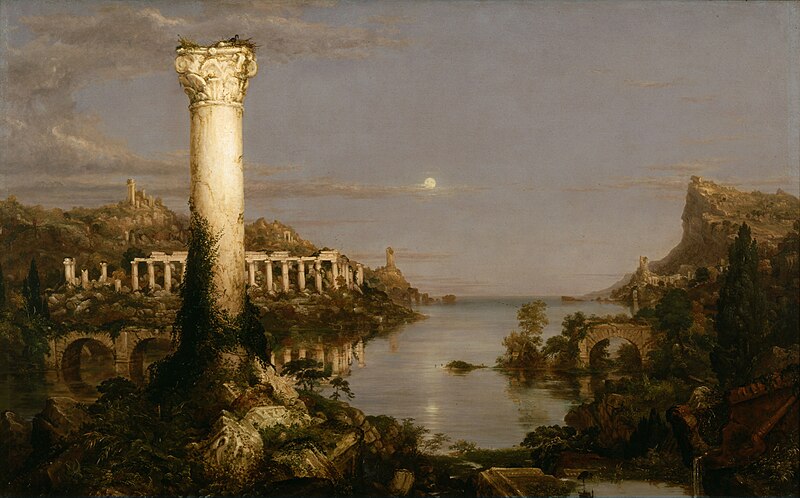
Upon his return to America, Cole applied the lessons he had learned abroad to create the five-part series The Course of Empire (1834–36). These works reveal a definition of the new American Sublime that comes to its fullest expression in The Oxbow (1836). Finally, the exhibition concludes with an examination of Cole's legacy in the works of the next generation of American landscape painters whom Cole personally mentored, notably Asher B. Durand and Frederic E. Church. Known for epic vistas, dramatic natural settings, and imaginative landscapes, Thomas Cole’s work depicts nature at its most powerful and vulnerable. His paintings glory in the unique terrain of the American Northeast – largely still unspoiled in his time - while serving as a cautionary tale about the use of natural resources in an increasingly industrial age. The exhibition includes 58 works, the majority on loan from North American collections. It includes Cole’s iconic painting cycle, 'The Course of Empire' (1834–6, New-York Historical Society) and the masterpiece that secured his career and reputation – and which has never been seen in the UK before - 'View from Mount Holyoke, Northampton, Massachusetts, after a Thunderstorm - The Oxbow' (1836, Metropolitan Museum of Art, New York). Cole’s paintings are shown alongside works by British artists with whom he was personally acquainted, as well as those who influenced him most, including Joseph Mallord William Turner and John Constable. A self-taught artist from Bolton, Cole is recognised as the father of landscape painting in the US. His career was shaped by his formative years labouring in the textile mills north of Manchester, and by his later study of the European masters whose works he travelled to see in London, Paris, and Rome. Christopher Riopelle, The Neil Westreich Curator of Post-1800 Painting at the National Gallery, says: “Cole is not as well-known here as in America, where his works are hugely admired. The story this exhibition tells, however, is a fascinating and novel lesson in international artistic exchange. A young émigré returns to Britain and travels on to the Continent to learn about contemporary European landscape painting and then carries the lessons home where, almost single-handedly, he forges the American landscape tradition.“ Not long after arriving in London, the young artist saw  John Constable, 1776–1837, British, Hadleigh Castle, The Mouth of the Thames--Morning after a Stormy Night, 1829, Oil on canvas, Yale Center for British Art, Paul Mellon Collection 'Hadleigh Castle, The Mouth of the Thames - Morning after a Stormy Night' (1829, Yale Center for British Art, New Haven) by Constable, with whom he developed a friendship and exchanged letters and sketches. An admirer of Turner, Cole visited his studio, but was somewhat confounded by the image the artist presented of himself. A bit rough around the edges and artistically experimental, Turner did not resemble the image Cole had of an artist of international repute. Cole had hoped to make a successful debut for himself exhibiting his paintings of American landscapes in London, but was met with a frustrating indifference from the city’s art elite, and so decided to move on to the Continent. Arriving in Florence in 1831, Cole spent a productive eight months studying the figure and honing his plein-air sketching skills in the company of a small community of American artists. Drawn to the countryside favoured by Claude, he later spent several months in and around Rome. Working outdoors, he sketched an aqueduct in the campagna and the picturesque town of Tivoli, both of which feature in paintings he completed back in his Florentine studio including  'A View near Tivoli (Morning)' (1832, The Metropolitan Museum of Art, New York)  and 'Aqueduct near Rome' (1832, Mildred Lane Kemper Art Museum, Washington). The landscape, antiquity, and likely the camaraderie he found, were a rich source of inspiration for the rest of Cole’s life. In the five years following his return to New York late in 1832, Cole painted his greatest works in response to his time abroad. Working from drawings and oil studies, he completed his epic painting cycle 'The Course of Empire' and 'The Oxbow' almost simultaneously in this period - both of which may be seen as the culmination of what he took away from his experiences in London, Florence, and Rome. 'The Course of Empire' depicts the rise and fall of an imaginary civilisation in an ancient style, but was intended to highlight the dangers of politics and commerce. It could not have been made but for those months in Italy. 'The Oxbow' was a challenge to the American public to consider its place in the natural world, and to keep in check the seemingly inevitable drive toward destruction. Before his untimely death in 1848 at the age of 47, Cole launched the first American school of landscape art by addressing the subject of a new country’s development with respect to its relationship with nature. Ultimately, generations of artists were influenced by Cole’s vision and resonance with the natural world, although they went in different philosophical directions with the changing of the times. Frederic Edwin Church, a key figure in the Hudson River School of painting, and Asher Brown Durand were devoted students of Cole, both of whom created works in homage to their mentor –  Church’s 'Above the Clouds at Sunrise' (1849, Private Collection)  and Durand’s 'Kindred Spirits' (1849, Crystal Bridges Museum of American Art) both specifically reference Cole’s passing and are seen in the exhibition. |

The Mountain Ford | Thomas Cole | 15.30.63 | Work of Art ...
A View near Tivoli (Morning) | Thomas Cole | 03.27 | Work of Art ...

View on the Catskill—Early Autumn | Thomas Cole | 95.13.3 | Work ...
The Metropolitan Museum of Art
Consummate works by J.M.W. Turner and John Constable, among others, will reveal Cole's engagement with European art, while masterworks by Asher B. Durand and Frederic E. Church will demonstrate Cole's extraordinary legacy in establishing a school of 19th-century landscape art in America.
Thomas Cole's Journey: Atlantic Crossings opens at the Metropolitan Museum of Art on January 30, 2018, and travels to the National Gallery London in June 2018.
With his work seldom seen outside the USA, this exhibition establishes British-born Cole (1801–1848) as a major global figure in 19th-century landscape art.
It also marks the first time that Cole’s monumental cycle of paintings The Course of Empire (1833–36, New York Historical Society) has been shown in the UK, and provides a vivid new context for
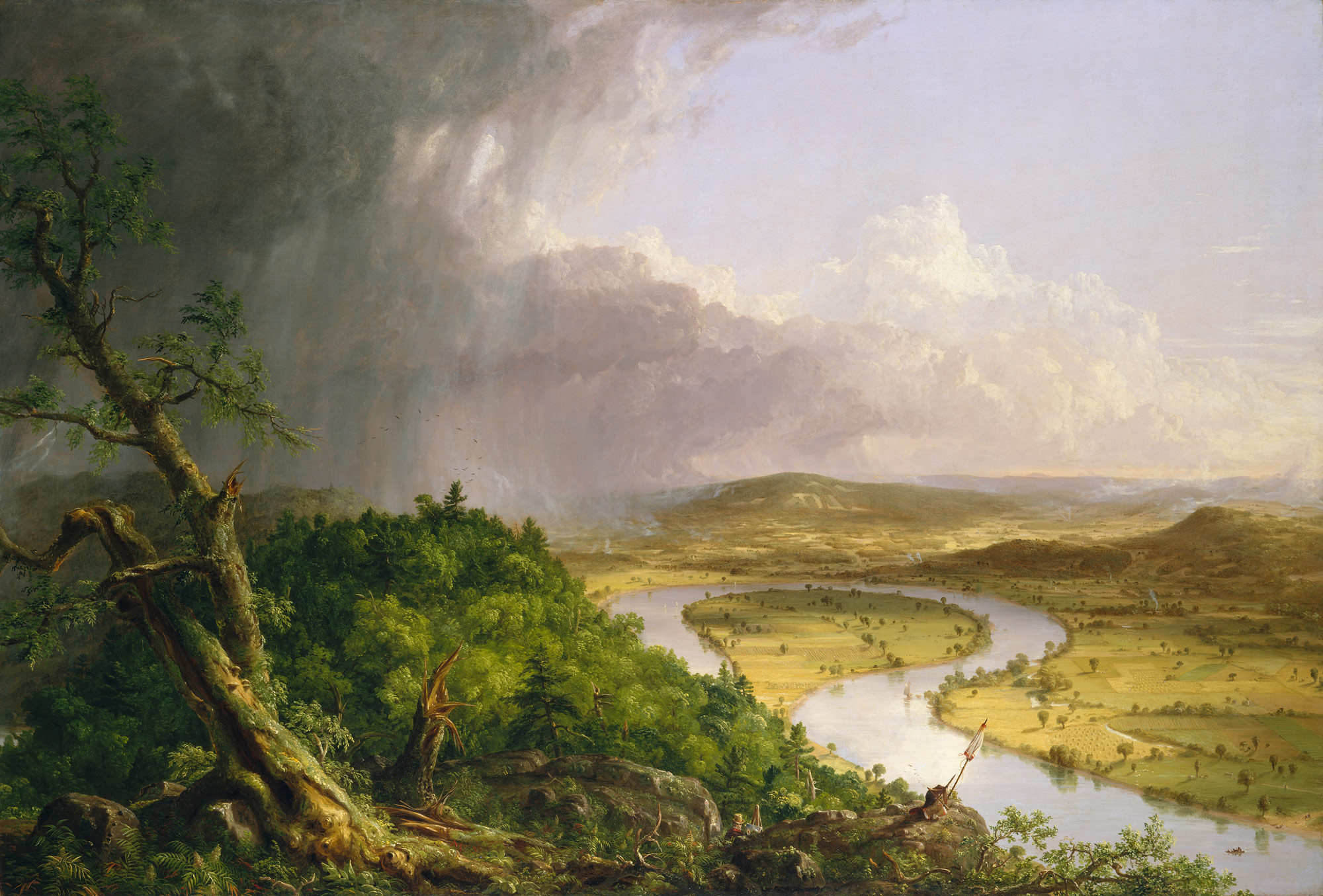
Cole’s The Oxbow (1836, The Metropolitan Museum of Art); a founding masterpiece of American landscape painting
Thomas Cole's Journey is curated by Elizabeth Kornhauser, Alice Pratt Brown Curator of American Paintings and Sculpture, Metropolitan Museum of Art, Tim Barringer, Paul Mellon Professor in the History of Art, Yale University, and Christopher Riopelle, Curator of Post 1800 Paintings, National Gallery, London.

The Course of Empire – The Savage State;

The Course of Empire – The Arcadian or Pastoral State;

The Course of Empire – The Consummation of Empire;
Catalogue

Thomas Cole (1801–1848), arguably the greatest American landscape artist of his generation, is presented here in a new light: as an international figure, born in England, and in dialogue with the major landscape painters of the age, including J.M.W. Turner and John Constable. Cole traveled in Europe from 1829 to 1832. Thomas Cole’s Journey reexamines his seminal works of 1832–36—notably The Oxbow and Course of Empire—as a culminating response to his experiences of British art and society and of Italian landscape painting. These, combined with Cole’s passion for the American wilderness and his horror of the industrial revolution in Britain, led him to create works that offer a distinctive, even dissident, response to the economic and political rise of the United States and the ecological changes then underway. This groundbreaking book also discusses Cole’s influence on later artists, from Frederic Edwin Church to Ed Ruscha.
Thomas Cole's Journey: Atlantic Crossings opens at the Metropolitan Museum of Art on January 30, 2018, and travels to the National Gallery London in June 2018.
With his work seldom seen outside the USA, this exhibition establishes British-born Cole (1801–1848) as a major global figure in 19th-century landscape art.
It also marks the first time that Cole’s monumental cycle of paintings The Course of Empire (1833–36, New York Historical Society) has been shown in the UK, and provides a vivid new context for
Cole’s The Oxbow (1836, The Metropolitan Museum of Art); a founding masterpiece of American landscape painting
Thomas Cole's Journey is curated by Elizabeth Kornhauser, Alice Pratt Brown Curator of American Paintings and Sculpture, Metropolitan Museum of Art, Tim Barringer, Paul Mellon Professor in the History of Art, Yale University, and Christopher Riopelle, Curator of Post 1800 Paintings, National Gallery, London.
The Course of Empire – The Savage State;
The Course of Empire – The Arcadian or Pastoral State;
The Course of Empire – The Consummation of Empire;


Thomas Cole, The Course of Empire Destruction, 1836(The New-York Historical Society )
Thomas Cole, The Course of Empire Desolation, 1836
(The New-York Historical Society )
Catalogue
Thomas Cole (1801–1848), arguably the greatest American landscape artist of his generation, is presented here in a new light: as an international figure, born in England, and in dialogue with the major landscape painters of the age, including J.M.W. Turner and John Constable. Cole traveled in Europe from 1829 to 1832. Thomas Cole’s Journey reexamines his seminal works of 1832–36—notably The Oxbow and Course of Empire—as a culminating response to his experiences of British art and society and of Italian landscape painting. These, combined with Cole’s passion for the American wilderness and his horror of the industrial revolution in Britain, led him to create works that offer a distinctive, even dissident, response to the economic and political rise of the United States and the ecological changes then underway. This groundbreaking book also discusses Cole’s influence on later artists, from Frederic Edwin Church to Ed Ruscha.
Comments
Post a Comment